
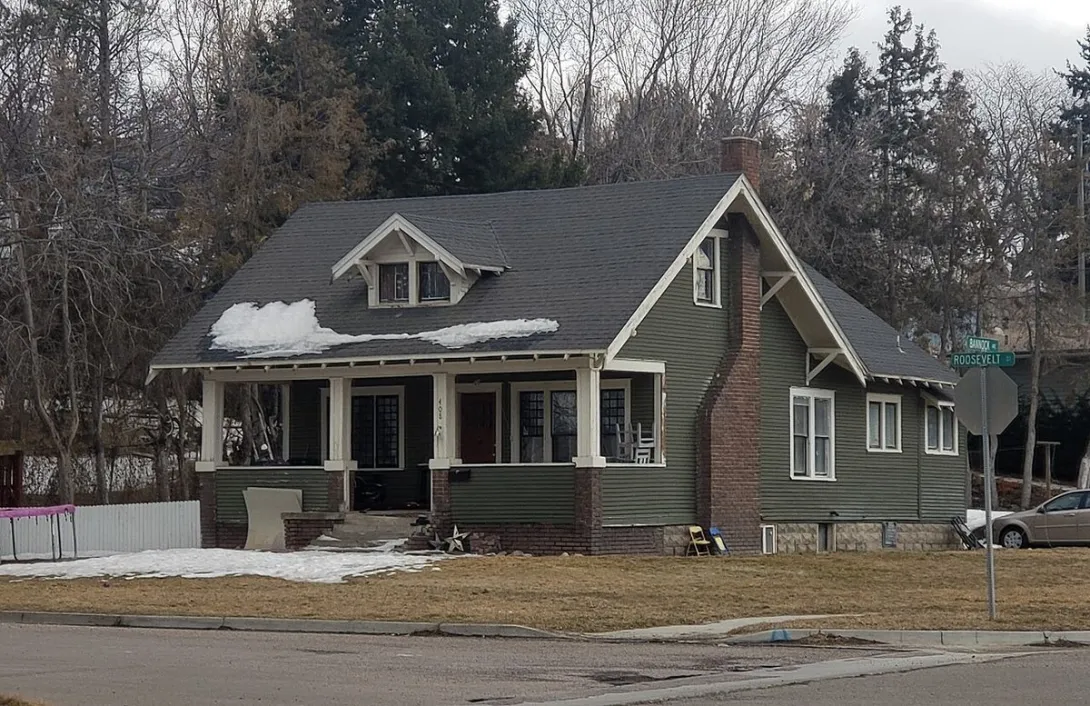
You can still walk past one of my moved houses today, and it still looks at home. At 408 Roosevelt Street in American Falls stands the Walter Sparks House, a one-and-a-half-story Bungalow and Craftsman house built in 1907, long before my first dam rose across the Snake River. Its National Register nomination describes a compact house, 25 by 34 feet, set on a concrete basement. It began its life in the old town, in the path of the reservoir that my construction would create.
In 1925 the Bureau of Reclamation moved the house, garage and all, to its present lot to clear the way for the water. A rear porch was added that year, after the move, so the building carries both dates honestly: 1907 for its original construction and 1925 for its relocation and adaptation to the new town. It is also known as the Houk House. That double identity is typical of the surviving moved buildings here, which are at once pioneer-era homes and artifacts of the largest decision the town ever made.
The house was listed on the National Register of Historic Places on February 7, 2007, under the American Falls Relocated Townsite multiple property listing, with National Register reference number 07000002. The National Park Service records its areas of significance as politics and government and community planning and development. Those categories may sound abstract until you stand at the corner of Bannock Avenue and Roosevelt Street and look at a green bungalow with snow on its roof, a broad porch, and a family neighborhood around it.
That ordinariness is exactly the point. The Sparks House was not preserved as a roped-off museum piece. It remained a home in a living neighborhood, part of the new American Falls that residents rebuilt after the move. Its significance lies in survival through relocation, in the craftsmanship of a modest Craftsman bungalow, and in the fact that a house built for one townsite could be hauled uphill and go on serving the next one.
Walk the relocated streets and you will find my story told at domestic scale. The Davie House and the Warwas House tell their own versions of it, and the Sparks House adds another, at a prominent corner near the heart of the new town. A dam can be measured in feet and acre-feet, but a moved house is measured in porches, chimneys, and winters weathered in two places. At 408 Roosevelt Street, both measurements still stand.
