
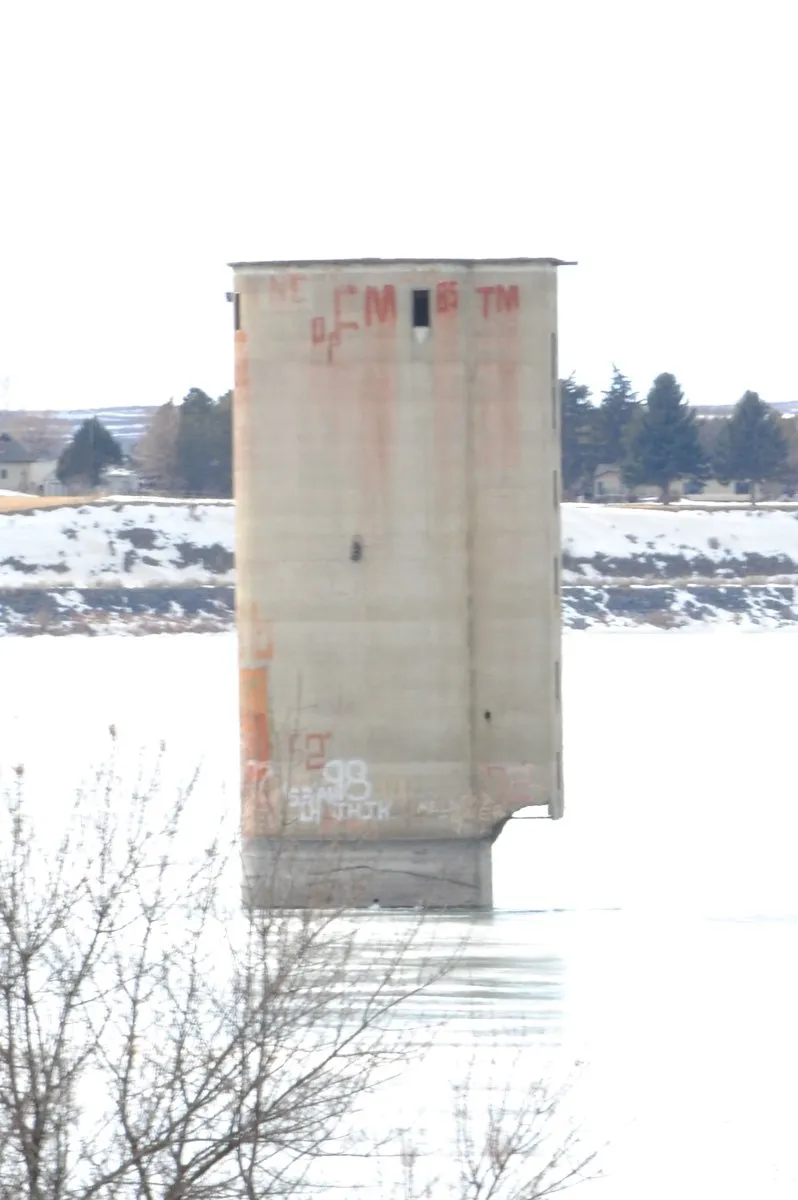
Good morning from the dam, on a cloudy Friday, November 27, here in American Falls. Today is expected to reach about 47 degrees, with south-southwest winds and rain arriving tonight, and sunset is near 5:00 p.m. Behind me, American Falls Reservoir is still refilling: Bureau of Reclamation Hydromet readings early this morning put the water surface at 4,326.46 feet, with 457,027 acre-feet in storage. As the water rises, it is a good day to remember the town that once stood where much of that water now rests.
American Falls is often described as the first town in the United States to be entirely relocated. When the Bureau of Reclamation built the first American Falls Dam, begun in 1925 and completed in 1927 as part of the Minidoka Project, residents had to move three-quarters of their town to higher ground to make room for the reservoir. Buildings were hauled uphill, a new townsite was laid out southeast of the old one, and a community rebuilt itself so that irrigation water could be stored for farms across south-central Idaho.
One structure never moved. The Oneida Milling and Elevator Company grain elevator, built in 1912 by the Flinton Construction Company, is a reinforced-concrete cylinder 106 feet tall and 36 feet in diameter. It was the first concrete grain elevator on the original townsite, and in 1925 its interior equipment and attached wooden buildings were removed and the elevator itself was left in place. The Bureau of Reclamation notes that it remains the only visible marker of the old townsite, standing offshore in the reservoir, and it was listed on the National Register of Historic Places on July 16, 1993.
The story did not end with the first dam. Core samples in the early 1960s showed deterioration in the original concrete, and a second American Falls Dam was completed downstream in 1978, after which the original structure was demolished. In 1976, Idaho Power built the current power plant, with three generators and a capacity of 112,420 kilowatts. The submerged remains of the original town were listed on the National Register in 2002 as the American Falls Reservoir Flooded Townsite, and the Bureau notes that sidewalks, roads, and building foundations can be observed during periods of low water.
For a visit that puts those stories in order, start in town. The Power County Historical Museum, at 500 Pocatello Avenue in American Falls, occupies part of the old Bethany Deaconess Hospital and features exhibits on the history and development of Power County, including the era when the town was relocated for the dam. The museum offers a walking tour of the places that were moved, a research library, and a large collection of historical photographs. Its listed seasonal hours run from May through Labor Day, so in late November visitors should call ahead to ask about scheduling a tour.
From town, a careful look from shore toward the elevator tells the rest of the story without needing to walk the reservoir bed. The elevator is a protected historic structure, and what can be seen changes with the water level from week to week. Dress for a cold, windy shoreline today, enjoy the history that is still standing in the water, and thank you for spending part of your Friday with American Falls.
