
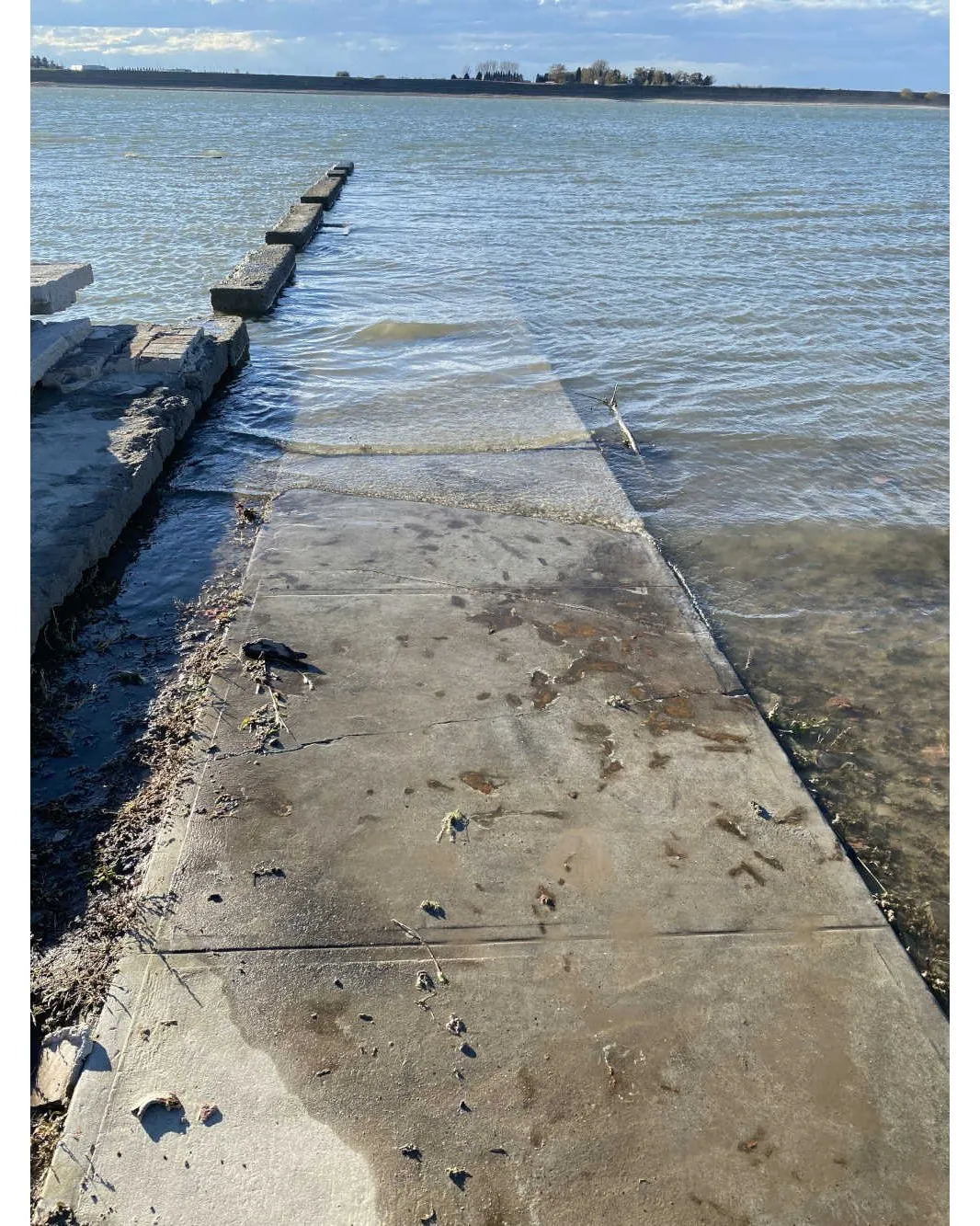
My old town never really left. It sleeps beneath my reservoir, north of the American Falls that stands today, and in low-water years its sidewalks, roads, and building foundations still emerge to remind everyone what was given up so farms across southern Idaho could have stored water.
The original town was an established community when the growing need for agricultural water led the Bureau of Reclamation to move much of it to higher ground in the mid-1920s. Buildings that could travel went up the hill, while the lower townsite was cleared for flooding. What remained behind was not rubble alone, but the pattern of a town: foundations where businesses stood, sidewalks that still run in straight lines, and depressions that mark where homes and public buildings once held daily life.
On January 28, 2002, that submerged landscape was listed on the National Register of Historic Places as the American Falls Reservoir Flooded Townsite. Reclamation describes the site as the submerged remains of the original town, located in the reservoir behind the dam, and notes that some original features have been damaged by erosion over the years. The National Register nomination describes a place that is only visible during low-water years, and that has changed little when it is exposed.
That rhythm of hiding and revealing is part of what makes the townsite so powerful. Most historic places can be visited on any day, but this one keeps the calendar of the reservoir itself. When the water is high, the old town is a memory held under the surface. When the water falls, a visitor walking the shore can trace a sidewalk straight toward the water and feel, for a moment, the street continuing on beneath the waves.
Today the story is also preserved beyond the shoreline. Boise State University's Atlas of Drowned Towns keeps the history of displaced western communities alive in a digital archive and interactive map, and American Falls belongs in that company. The project matters because a flooded town can disappear twice, first under water and then from memory, and careful recording keeps the second loss from happening.
So when you stand at my shore in a dry fall and see concrete appearing at the water's edge, look closely and tread respectfully. Those are not random ruins. They are the streets of the first American Falls, the town that moved so that a reservoir, a new town, and a farming region could all take shape around it.
