
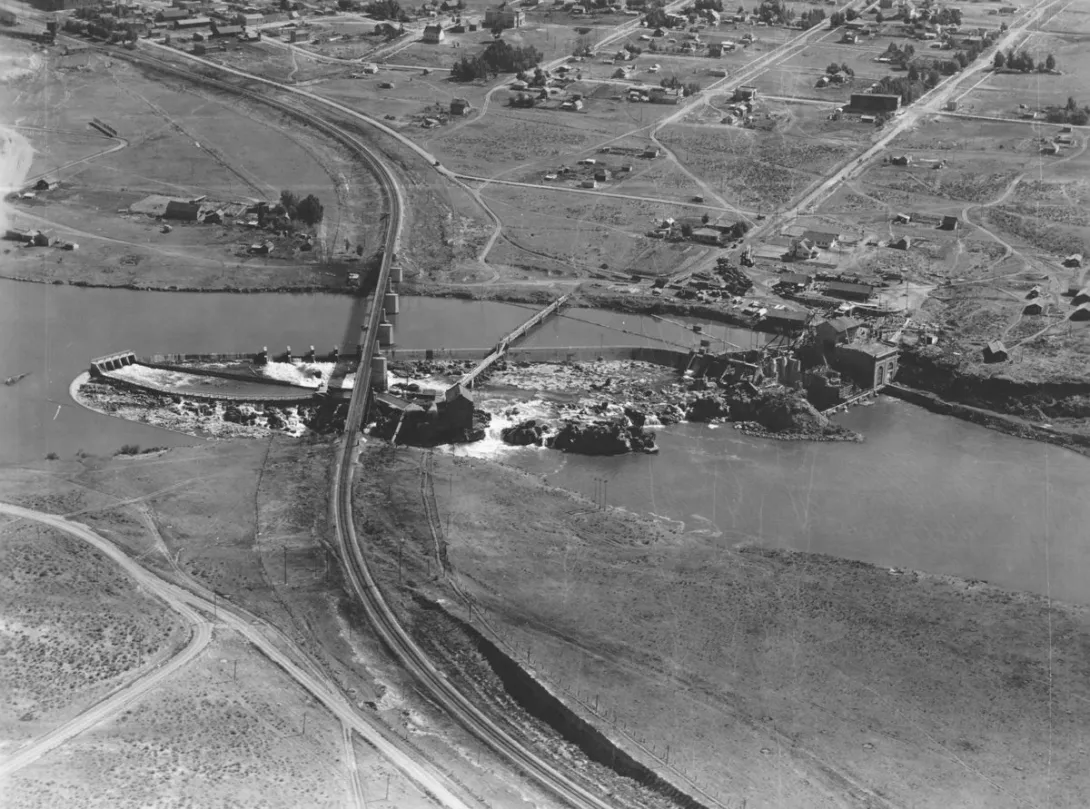
Long before I held this river back, the Snake River did its own dramatic work here. Squeezed through a narrow bottleneck of black basalt, the river fell about fifty feet in a series of stair-step cascades, dropping six to ten feet at a time over the jointed rock. The thunder of the falls could be heard for miles across the sagebrush plain, and for everyone traveling west, that sound was a promise: you were getting close to American Falls.
The falls earned their name the hard way. Local tradition, recorded by the Idaho State Historical Society, holds that the falls were named for a party of American fur trappers whose boat went over the cataract. The Wilson Price Hunt expedition camped beside the falls for a night in 1811, and John C. Frémont camped here in 1843 and wrote the name American Falls in his journal. From then on, the falls were a famous landmark for fur trappers and early western travelers alike.
For emigrants on the Oregon Trail, which passed north of the later townsite through ground my reservoir now covers, the falls were one of the most anticipated sights of the whole journey. Forty-niner Wakeman Bryarly wrote that the distant rumbling of the falls broke the monotony of the march and left his party anxious to see them. In 1850, Leander Loomis recorded that his wagon train stopped its teams and went down to look, finding a continual rainbow at the foot of the falls while the sun was shining. People crossed a continent on foot and still made time to stand and stare.
A landmark became a crossing, and a crossing became a town. Sustained settlement began around 1880, and in 1881 a ferry was established across the Snake River above the falls. A post office followed in April 1882. The Oregon Short Line Railroad chose this crossing for a head-of-rail construction camp as it built west, and its line passed through in late 1882 and early 1883, carrying the crossing on iron rails over the river. The town was platted in 1886 and grew into a trading and shipping center for the ranches of Power County. The river crossing was so important that when my reservoir filled decades later, the railroad had to raise its bridge here by twenty-two feet to stay above the water.
The building of my first dam between 1925 and 1927 changed the river forever, and the rising reservoir submerged most of the historic cascades. But the story is not entirely underwater. The uppermost falls still pours out below me, and it is especially impressive during spring runoff, when the Snake runs high and loud again. You can see it from the overlook at the west end of Falls Avenue or from Trenner Park, where a footpath follows the river upstream toward my base. Stand there on a bright morning, and you may catch what Loomis saw in 1850: sunlight, falling water, and a rainbow hanging over the Snake.
