
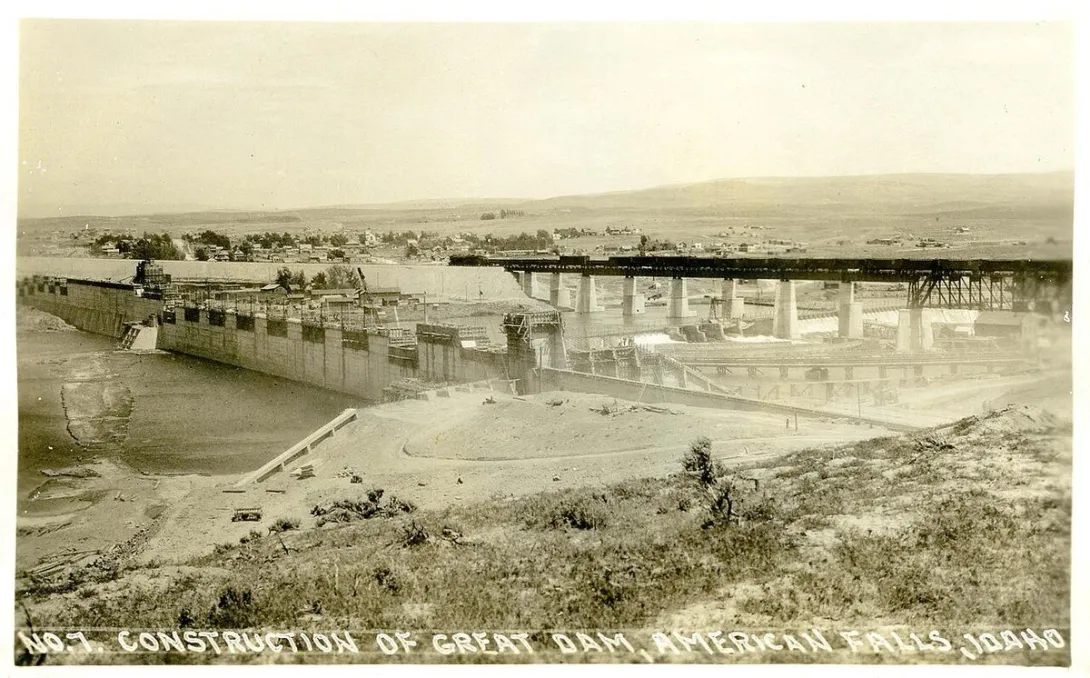
I remember the day my cornerstone was sealed. The work had begun months earlier, when Utah Construction Company won the contract to build the first American Falls Dam with a bid of 1,936,000 dollars, accepted on October 16, 1924. The first dirt moved on March 10, 1925, and through that spring and summer the riverbank at American Falls became one of the largest construction sites in Idaho, as crews prepared to hold back the Snake River for the Bureau of Reclamation's Minidoka Project.
On July 13, 1925, a great crowd gathered at the site as the Secretary of the Interior sealed my cornerstone in place. Cornerstone ceremonies were serious civic occasions in that era, part construction milestone and part public promise. For the people watching, many of whom were preparing to move their homes and businesses out of the reservoir's path, that sealed stone said the project was real, permanent, and worth the sacrifice the town was making.
The building sequence was shaped by the river and by a change of plans. Crews built the east half first while Reclamation decided to make the dam larger, and then they laid the west foundation in early 1926. Cofferdams held the Snake aside section by section, concrete rose in stages, and the work continued through the same months when the town relocation, which ran from January 22, 1925, to July 29, 1926, was at its height. Dam and town were being rebuilt at the same time, within sight of each other.
In October 1926, my fifteen radial gates went in, the last cofferdams came out, and the reservoir began to fill for the first time. Sources differ on the first dam's completion, and that difference should be stated honestly: the City of American Falls and the Idaho State Historical Society give April 21, 1926, while the Bureau of Reclamation gives 1927, and final work was still being finished in April 1927. Both dates remain part of the record, reflecting the difference between a dam that was functioning and a project that was fully complete.
That first dam served for half a century before the replacement dam, authorized on December 28, 1973, was completed in 1978. The cornerstone day still matters because it marks the moment when an idea debated for years became concrete, steel, and stored water. Every harvest irrigated from this reservoir since then traces back, in part, to a crowd on a July day in 1925, watching a stone sealed into a rising wall.
