
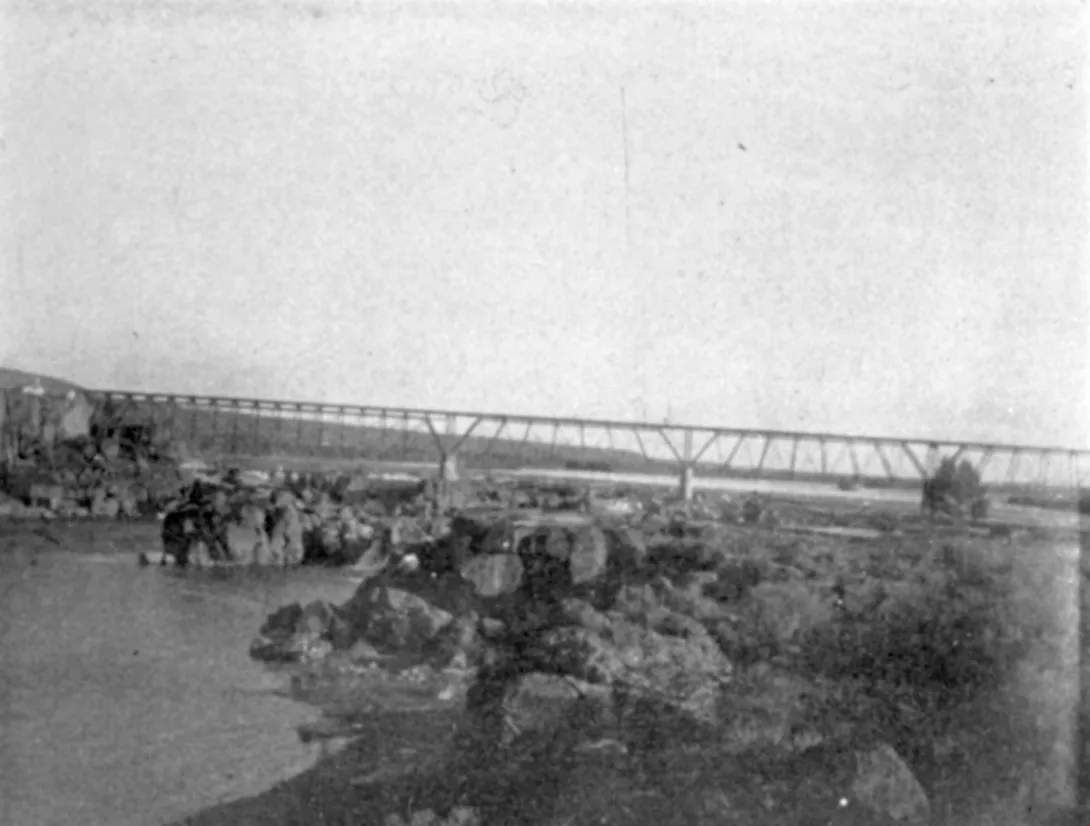
Before there was a dam at American Falls, there was a bridge, and in many ways that bridge made this town. In the summer of 1882, the Oregon Short Line pushed its tracks west across the Snake River Plain toward this crossing of the Snake River. Crews built a large bridge across the river here, and for that summer American Falls was the end of the line, a busy head-of-rail construction camp on the road from Granger, Wyoming, to Huntington, Oregon.
A railroad bridge changed what this place could be. Before the rails arrived, the falls were a landmark for trappers, emigrants, and the Shoshone and Bannock peoples who had known this river for generations, but a settled town needs a reliable way to move people, mail, livestock, and farm goods. The bridge and the tracks gave the young community that connection, and trains were passing through by late 1882 and early 1883. Stores, homes, and services followed the railroad, and the crossing gave American Falls its start as a real town rather than a seasonal camp beside the river.
The bridge also explains the shape of the town that grew up around it. Railroad towns were laid out for work, with depots, warehouses, and streets serving the line as much as the river. American Falls was platted in the 1880s in that railroad era, and for more than forty years the bridge carried the main line over the Snake while farms and ranches across Power County shipped their produce out and brought supplies in by rail.
Then, in the 1920s, the river itself changed the bridge. When the Bureau of Reclamation built the first American Falls Dam, the new reservoir was going to flood miles of track and cover the old crossing. Power County history records the scale of the fix plainly: the Oregon Short Line bridge had to be raised 22 feet higher so trains could cross the new reservoir. The town moved uphill, the tracks moved, and the bridge rose to meet a landscape that my reservoir was remaking.
That is why I tell this story as more than railroad nostalgia. The bridge came first, and it taught this community how to connect itself to the wider world. The dam came later, and it asked that same community to rebuild nearly everything, including the crossing that had created it. When you cross the Snake at American Falls today, you are following a route chosen in 1882, lifted in the 1920s, and still central to how this town understands itself.
