
When visitors stand on my crest and look out across American Falls Reservoir, few realize they are looking over a town. Before my gates first closed, American Falls stood in the low ground along the Snake River, a Power County seat of brick storefronts, banks, hotels, churches, and grain elevators. The broad basin that made such a good reservoir would flood roughly three-quarters of that town, so before the water could rise, the town itself had to move.
The Bureau of Reclamation, which built me as part of the Minidoka Project, did not simply leave people to scatter. It planned a new, designed community on higher ground to the southeast, in what became known as the Reclamation Addition, and laid out a fresh town around a central square. Buildings worth saving would travel to new lots there, while the railroad line and power lines were rerouted around the ground my reservoir would cover.
The moving began on January 22, 1925, when the first building was hauled away from the old townsite, and it grew into one of the largest government relocation projects of its time. Reclamation records account for 329 properties, and the tally of what rolled uphill included homes, 46 businesses, three hotels, five churches, a school, and six grain elevators. Crews jacked buildings onto rollers and wheeled carts and dragged them along a graded Moving Road behind steam traction engines and tractors. In June 1925, the St. John Lutheran Church stalled on its rollers over a weekend, and its congregation climbed up and held Sunday service inside the church while it sat mid-move in the roadway.
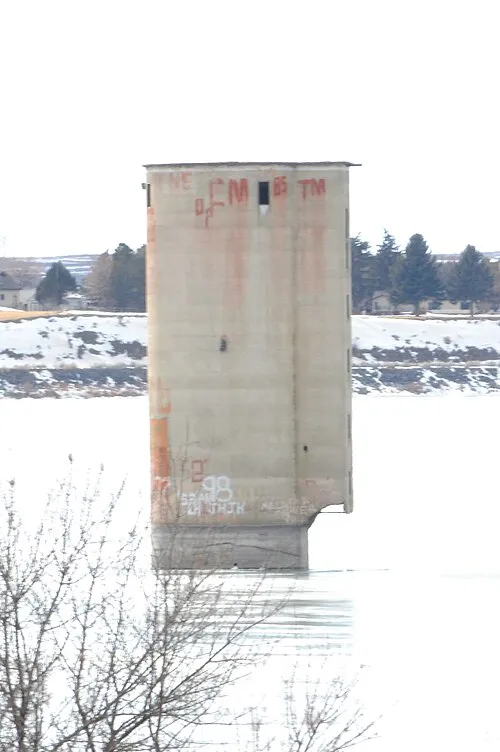
Not everything could travel. Large masonry buildings that could not be hauled intact were demolished for salvage and rebuilt in the new town instead. One structure never moved at all: the Oneida Milling and Elevator Company grain elevator, built in 1912 of reinforced concrete, 106 feet tall, and rooted so deeply that it was judged too solid to move. Reclamation stripped away its wooden sheds and docks and left the bare concrete tower standing alone on the old townsite.
On July 29, 1926, the Moving Road across the dam was officially closed, ending the relocation of American Falls. The old streets then slipped beneath my rising reservoir, where their sidewalks, foundations, and lot lines still rest today, reappearing when low water pulls the reservoir back. The flooded townsite was listed on the National Register of Historic Places in 2002, and the lone grain elevator, listed in 1993, still rises offshore as the one visible marker of the town that moved so that I could hold its water.
