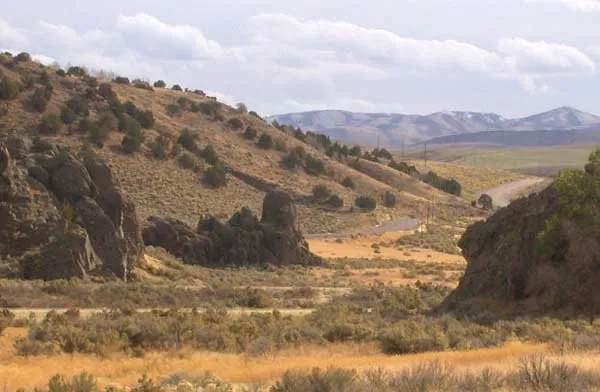
West of American Falls, the Oregon Trail crossed one of the most storied passages on the whole route west. During the emigrant era of 1840 to 1860, thousands of travelers who had left Fort Hall and crossed the Snake River Plain, more than 1,200 miles out of Missouri, reached a place where the trail narrowed to a gap between enormous basalt boulders on the south bank of the Snake River. Wagons had to pass through in single file. Emigrants called the gap Devil's Gate, and some called it the Gate of Death.
The boulders are the remains of an extinct volcano, according to Idaho State Parks, which notes that Devil's Gate Pass is all that remains of it. The rocks were also a natural campsite, and wagon trains regularly stopped among them on the journey. Today Interstate 86 follows the course of the historic Oregon Trail through what is now Massacre Rocks State Park, and the famous gap itself was widened in the 1990s to make room for the interstate, so the trail trace no longer survives at the gap itself.
The violence that gave the rocks their name happened nearby, but not at the rocks themselves. On August 9 and 10, 1862, wagon trains traveling east of the rocks were attacked. A detailed park narrative compiled from emigrant diaries, including the diary of Charles Harrison, describes attacks on August 9 involving the Smart, Adams, Kennedy, and Wilson wagon trains, in which five men were killed in the first two attacks. Two more men were killed in a later skirmish, with one more presumed dead, and Captain Adams's wounded daughter died on the evening of August 11, bringing the emigrant dead to ten. Five men believed to have been buried at Massacre Rocks are named in the narrative: A. J. Hunter, Masemo Lepi, George Adams, Charles Bulwinkel, and George Shepherd.
The National Park Service tells the story more cautiously. It notes that warriors carried out attacks on wagon trains along the Snake River in 1851, 1859, and 1861 and 1862, but that none of them occurred at the so-called Massacre Rocks. A skirmish a couple of miles east of the rocks killed eight emigrants and about twenty Bannock warriors. Very few emigrant journals even mention the gap, the Park Service adds, and research has shown that the ominous massacre legend was concocted by local tourism boosters in the early 1900s. The gap that emigrants supposedly dreaded was, in their own journals, barely noticed at all.
The name itself is a twentieth-century invention. The park narrative states that the name Massacre Rocks was bestowed in 1912, based on the 1862 attacks, although the skirmishes took place east of the park and not at Devil's Gate. A later history article likewise describes a newspaperman promoting the new name to draw tourists. Idaho State Parks, for its part, says only that Massacre Rocks derived its name from an emigrant wagon party skirmish. What is certain is that the boulders were a landmark on the emigrant road long before they had a frightening name, and that the ground east of them saw real bloodshed in August 1862.
Visitors today can still walk in the emigrants' tracks. Deep wagon ruts created on the Oregon and California Trails survive in the park, reached by paved trails northeast of the visitor center, and the visitor center offers exhibits and interpretive panels about the wagon trails. The gauntlet, it turns out, was mostly a story told afterward, but the ruts in the rock are real, and they still point west.