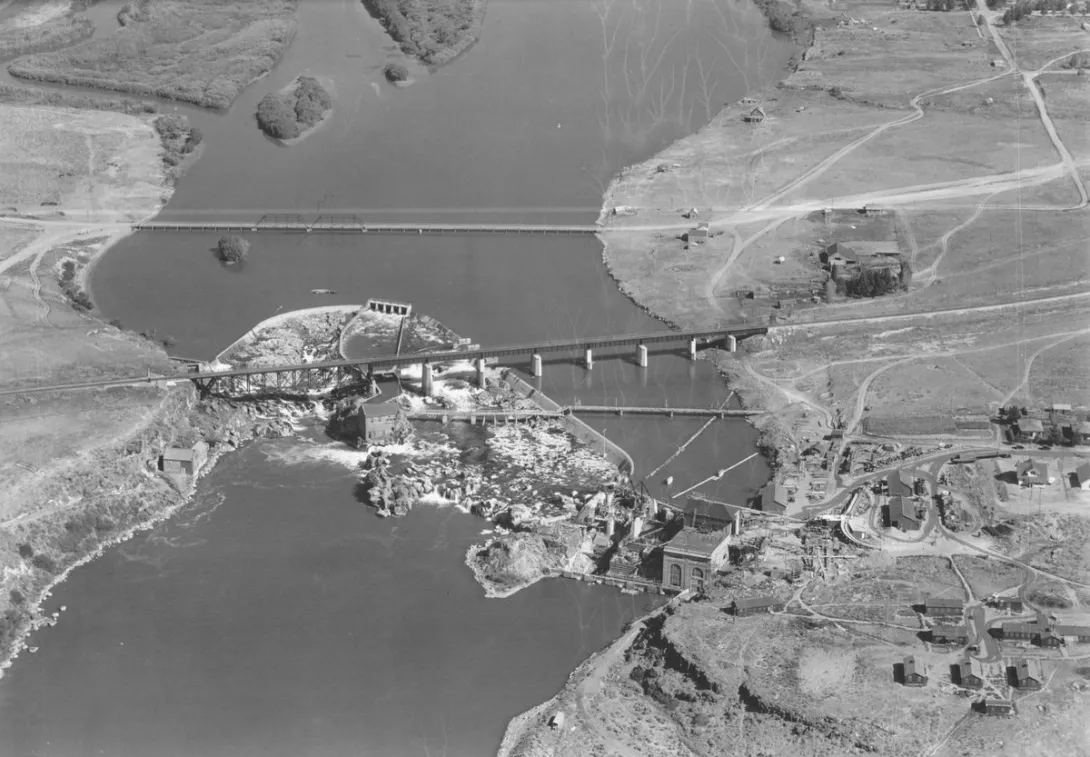
The first American Falls Dam was a federal dam. It was built by the United States Bureau of Reclamation as part of the Minidoka Project, the first Reclamation project constructed in Idaho, and the construction work was carried out under contract by the Utah Construction Company. Idaho Power Company did not build the dam. Its part in the story came earlier and later: it owned small hydroelectric plants at the natural falls, it held water rights that Reclamation had to buy out, and it built powerplants at the Reclamation dams in later years.
The idea had a long gestation. Limited testing of a dam site began in 1908, and a thorough geological investigation followed in 1918. A dam proposed in 1919 would have stored two to three million acre-feet of water, assured storage in drought years, and allowed the Minidoka Project's irrigated lands to expand. Of twelve possible dam sites along the Snake River, only American Falls had the capacity to provide adequate storage. The project was formally authorized on September 18, 1920, and twenty-one of thirty upper-river irrigation districts subscribed to 700,000 acre-feet of the proposed reservoir. Congress appropriated 1,735,000 dollars for surveys and property assessment.
The project nearly died in 1921. Reclamation had bought or contracted to buy ninety-three properties by July 1 of that year, and it negotiated a settlement under which Idaho Power would be reimbursed one million dollars for its water rights while retaining the use of its east side plant and reservoir water for power generation. In December 1921, however, Secretary of the Interior Albert Fall ordered the American Falls office closed and the project abandoned. Fall later agreed to revive the project if Idaho farmers funded half the cost. Voters formed the American Falls Reservoir District on January 16, 1923, the formation was confirmed on March 24, 1923, and after a favorable Idaho Supreme Court decision on July 23, 1924, the district sold 2,700,000 dollars in bonds on September 12, 1924.
With local and federal money in hand, the Bureau of Reclamation accepted the Utah Construction Company's bid of 1,936,000 dollars on October 16, 1924. The first dirt was excavated for the dam on March 10, 1925, and at a cornerstone dedication on July 13, 1925, Secretary of the Interior Herbert Work sealed the cornerstone. The finished structure was a composite concrete and earth gravity dam, described by Reclamation and the City as 94 feet high and 5,277 feet long, with about 800 feet of concrete spillway. Frank A. Banks, whose name appears in the record as the dam's designer, served as project manager and closed the town's moving road when the relocation ended.
When was the dam finished? The sources give two answers, and both deserve to be told. The City of American Falls and the National Register nomination state that the dam was completed sixty days ahead of schedule on April 21, 1926, that its gates were shut and spring runoff began collecting, and that it released its first irrigation water on May 2, 1926, at a total cost of 2,850,000 dollars. The Bureau of Reclamation's current environmental assessment, however, states flatly that American Falls Dam was completed in 1927, and Reclamation's own project history says that Utah Construction completed the final work in April 1927. The fairest reading is that the dam was storing and releasing water in the spring of 1926 while final construction work continued into 1927, which is why both dates have circulated ever since.