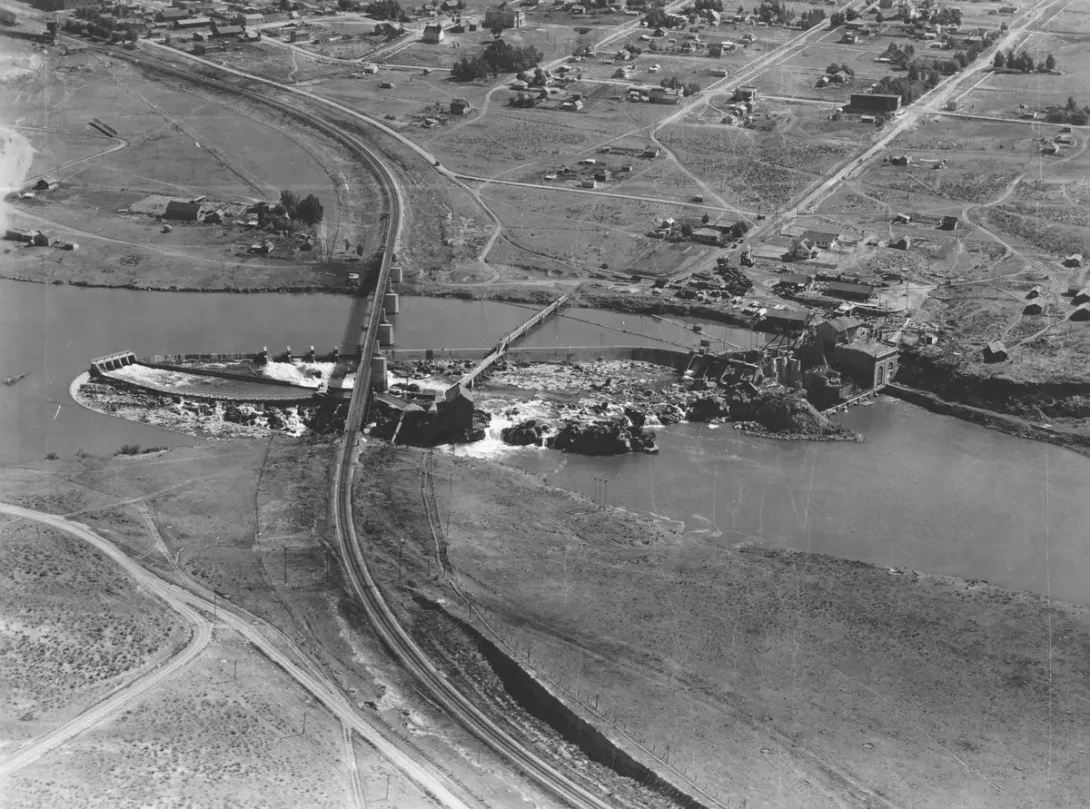
In 1925, the people of American Falls, Idaho, began moving their town. The Bureau of Reclamation was building a dam on the Snake River as part of the Minidoka Project, and the reservoir behind it would cover about three-quarters of the town. Rather than abandon the site, the residents and the federal government undertook what the City of American Falls describes as the largest government relocation project of its time: nearly the whole town picked up and moved, building by building, to higher ground.
The scale of the undertaking was remarkable. According to the National Register of Historic Places nomination for the flooded townsite, 344 residences, 46 businesses, three hotels, one school, six churches, one hospital, six grain elevators, and one flour mill were moved from the original town site. The Bureau of Reclamation purchased 329 properties in the Original Townsite and the Riverside, Union, and Kiers additions, and preliminary estimates put the cost of removal and relocation at 3 million dollars.
The new town rose on a 300-acre townsite called the Reclamation Addition, with 867 business and residential lots. County commissioners approved the plans in early September 1923, and lot sales began on October 4, 1923. Before the first building arrived, Reclamation spent 400,000 dollars preparing the site, laying seven miles of sewer line, nine miles of water mains, twelve miles of streets, and eight miles of sidewalks, and running power lines to more than 350 homes and businesses. The plan radiated from a central town square, and the streets were angled so that each home would receive a full measure of the morning sun. The City's history says that residents asked how they would teach their children north or south, and that the planners answered that the city was laid out so the sun could shine in every window.
The first building moved was the Theil Welding building, which Howard Douglas hauled to the new townsite on January 22, 1925. Building movers arrived that spring from as far away as Ohio and Texas, and a temporary moving road crossed the dam construction area and followed the old Oregon Trail up the hill to the Reclamation Addition. Progress was slower than the residents wanted. By April 20, 1925, twenty houses had been moved, and by June 11 only fifty buildings had made the trip, drawing complaints about the pace.
Some moments of the move became legend. On a Sunday in June 1925, the St. John Lutheran Church was caught on the moving road, still mounted on its wheels, and worshipers attended service inside the traveling building, an episode that made national news. The Grand Hotel, the largest building moved in 1925, took two weeks in late September to reach its present location on the town square. On October 8, 1925, Reclamation reminded residents of a December 1 deadline for clearing the old townsite, with the grain elevators excepted.
The heaviest work came last. The giant grain elevators were moved to the new Oregon Short Line right-of-way in late May 1926, and the old railroad depot made the final trip on the last opening of the moving road on July 13, 1926. On July 29, 1926, project manager F. A. Banks closed the moving road across the dam, officially ending the relocation of American Falls. Each August, American Falls Day celebrates the move with a parade and festivities in City Park, and the Chamber of Commerce counts the celebration's years from the move that began in 1925.