
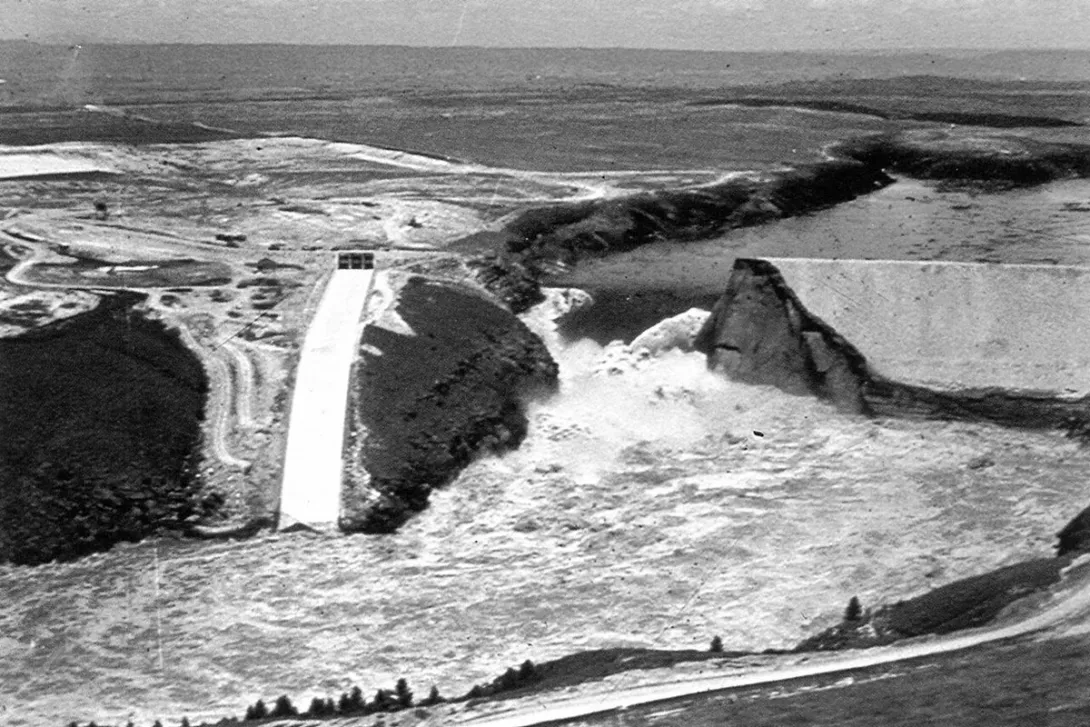
In 1976, I faced my hardest test. Upstream, the Teton Dam failed during its first filling, sending spring snowmelt racing down the Teton River toward the Snake River and, eventually, toward me. Communities downstream had little warning and a great deal to fear, and every reservoir and dam on the system suddenly mattered in a way that ordinary operations never demand.
To help contain the flood, water was released from my reservoir as quickly as possible, making room for what was coming. Then my reservoir filled with the arriving floodwater. Through it all, remarkably, my level never even rose to my spillway crest. I held. For a dam already known to be aging, it was a remarkable stand, and it remains one of the proudest chapters in my history.
That stand came from a structure whose weakness was already documented. Core samples taken in the early 1960s had revealed deterioration in the original dam's concrete, caused by a chemical reaction within the material itself. The first American Falls Dam, completed in the 1920s, with its completion date still recorded differently by different sources, was serving a growing region while its own substance slowly weakened.
Congress had already acted on that knowledge. My replacement was authorized on December 28, 1973, and in 1978 a new dam was completed just downstream, after which the original dam was demolished. So the flood of 1976 arrived in the narrow window between authorization and replacement, when the old dam was still the only dam there was. It met the test in its final years of service.
I tell this story as the second American Falls Dam, proven, in a sense, by a flood I never had to face and my predecessor faced for me. The lesson the valley took from 1976 was double: that dams demand honest inspection and timely replacement, and that a well-tended reservoir can be a community's protection as well as its water supply. Both lessons are written into the concrete that stands here today.
