
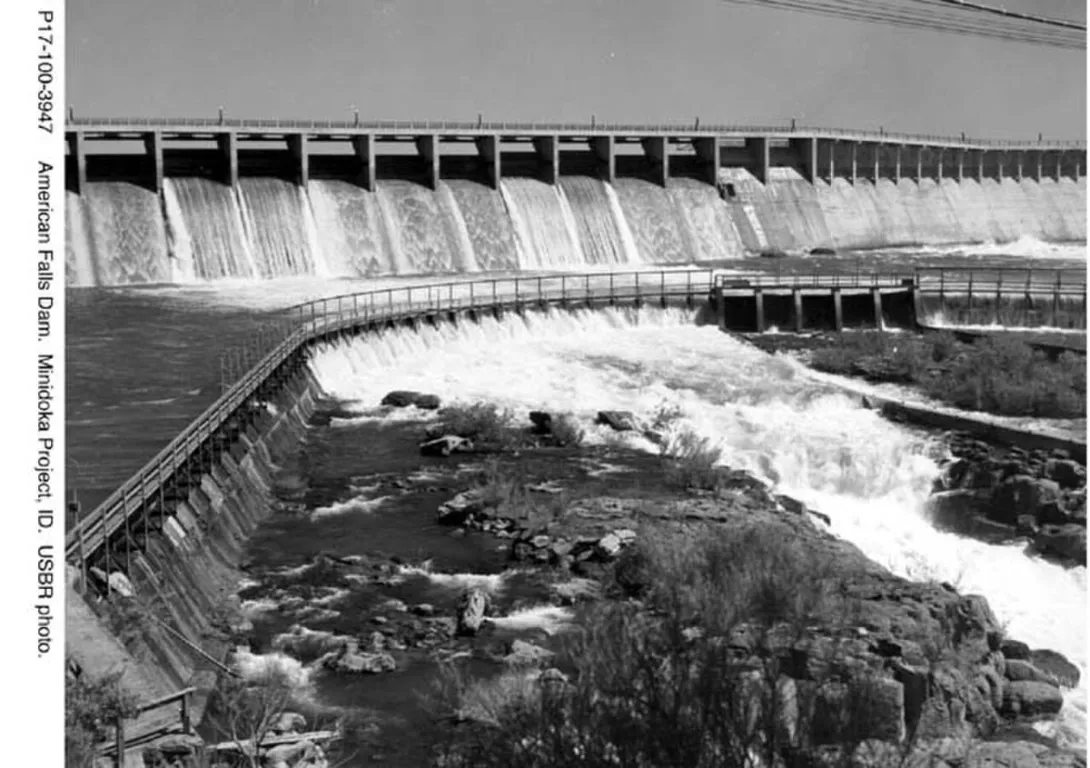
People who cross me on Highway 39 today are crossing my second self. I stand 94 feet high on the Snake River at river mile 714.7, holding back 1,700,000 acre-feet of water in the largest reservoir of the Bureau of Reclamation's Minidoka Project. I was built to store irrigation water for southern Idaho farms, and I still do that work every day, along with flood control, power generation, fish and wildlife habitat, and recreation. But the dam you see now is not the dam that first rose here.
My first self went up in the 1920s. The Bureau of Reclamation accepted Utah Construction Company's $1,936,000 bid on October 16, 1924, and the first dirt was excavated on March 10, 1925. That first dam was a concrete gravity structure with embankment wings, 103.5 feet high with a crest length of 5,277 feet. Even my completion date is part of my story, because the records do not agree: the City of American Falls and the Idaho State Historical Society give April 21, 1926, while the Bureau of Reclamation gives 1927. I present both, because both come from the people who built and lived beside me.
For decades my first concrete held, and my reservoir filled behind it. Then, in the early 1960s, a core-drilling program found trouble inside me that no one could see from the road. The concrete in portions of the dam was deteriorating because of a chemical reaction between alkalis in the cement and the aggregate, a reaction that was unknown at the time of construction. The deterioration cost the concrete strength and durability, and Reclamation placed a fill restriction on my reservoir that reduced its storage to about 66 percent of its maximum design capacity.
The answer was not a patch. It was a second dam. By a congressional act of December 28, 1973, Public Law 93-206, the American Falls Reservoir District, acting as the constructing agency for the storage spaceholders, was authorized to finance and contract for my replacement. Construction was completed in 1978, with a new dam built downstream, and the original structure was demolished. Reclamation then repaid the District, acquired title, and took back responsibility for operating and maintaining me. In 1976, while the replacement was underway, Idaho Power Company built my current powerplant, with three generators that make electricity from irrigation releases.
So when you look at the black-and-white photograph from 1947, you are looking at a dam that no longer stands, spilling spring water over the rocks below American Falls. I remember that first self with respect. It proved that stored Snake River water could transform this dry plain, and it served long enough for its hidden flaw to teach engineers a hard lesson. I carry its purpose forward in stronger concrete, in the same river, for the same farms and towns.
Photo: American Falls Dam in 1947, U.S. Bureau of Reclamation, public domain, via Wikimedia Commons.
