
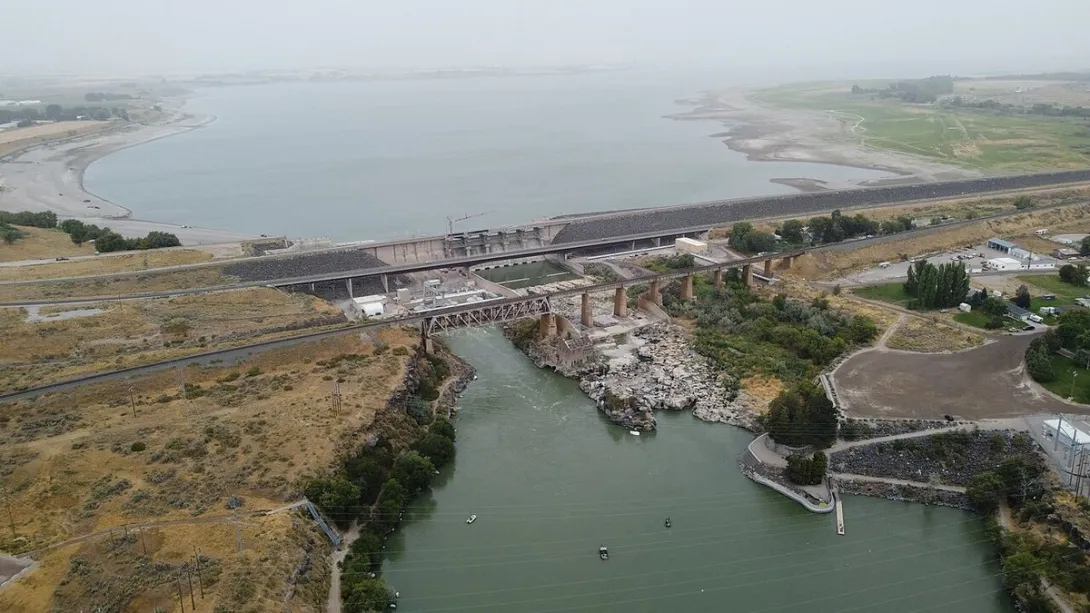
Here is a secret about my first price tag: the concrete wall itself was the cheap part. When the first American Falls Dam was completed and the reservoir first filled, the structure stretched 5,277 feet across the Snake River, almost exactly a mile, and rose 94 feet. Reclamation records describe a 94-foot-high dam with storage capacity of 1,700,000 acre-feet, the largest reservoir in the Minidoka Project. Just above the dam the valley forms a broad natural basin, so a comparatively modest wall could hold an enormous amount of winter water.
That storage was built mainly as insurance for land that was already being farmed. Rather than opening an entirely new irrigation frontier, the reservoir stored winter and spring flow and released it when the natural river ran low, supplying more than half a million acres served through about 20 irrigation districts. The economics only make sense when that purpose is kept in view. Farmers and districts helped carry the project because reliable late-season water protected crops they had already planted and communities they had already built.
Against that benefit, the dam structure accounted for only about a third of the total cost. The rest of the money bought the land that the new lake would cover. It paid to move about two miles of Union Pacific railroad track and to build a new bridge. It bought out earlier power rights at the falls. Above all, it paid to move an entire town uphill, lot by lot and building by building, from the ground that was about to go under water to the new townsite prepared above the shoreline.
That accounting changes how my history should be told. I am often described as a single engineering work, a wall across a river, but the project was really a valley-wide rearrangement. Fields, rails, power claims, streets, homes, churches, and a courthouse all had prices attached to them, and most of those prices had nothing to do with mixing concrete. The first dam completion date itself is genuinely conflicted, given as April 21, 1926 by the City and the Idaho State Historical Society and as 1927 by Reclamation, and both dates belong in an honest account.
So when you stand on my crest and look across a mile of structure, remember that you are seeing the visible minority of the investment. The larger share lies out of sight, in purchased acres beneath the reservoir, in a railroad on new ground, and in a town that still lives on the hill because the project paid to put it there. I was the cheap part, and the community around me was the expensive, enduring part.
