
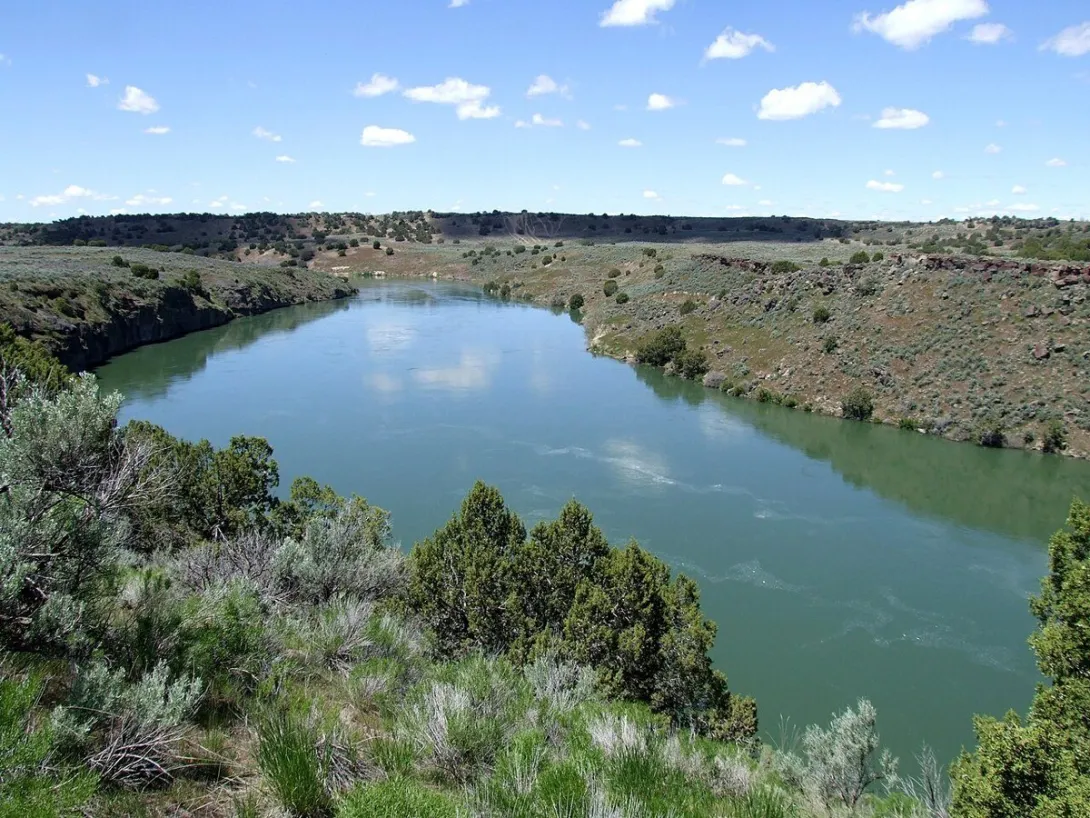
Downriver from me, the Snake River runs through a canyon that remembers far more than my concrete. The American Falls Archaeological District, listed on the National Register of Historic Places on July 1, 1999, protects a landscape of 158 contributing sites along the river downstream from the town of American Falls.
The Bureau of Reclamation describes the district's sites as representing human occupation in southern Idaho from roughly 12,000 to 14,000 years before the present through the Euro-American era. The sites range from small prehistoric stone scatters to larger features and historic structures connected with homesteading and mining. Taken together, they form one of the fullest records of life along this stretch of the Snake River anywhere in the region.
Two sites in the district, recorded as 10-PR-4 and 10-PR-431, were identified by Shoshone-Bannock members as traditional cultural properties, places tied to ceremonies, cultural practices, and tribal history. That identification matters, because the district is not only a collection of artifacts in the ground. It is a living cultural landscape, and the Bureau of Land Management notes that the Shoshone, Bannock, and Paiute peoples used this area as a winter campsite for thousands of years.
Other sites in the district show possible use reaching back some 8,000 years and more, and Reclamation research describes almost continuous occupation spanning more than 9,000 years, from Paleoindians to modern Native peoples to pioneers on the Oregon Trail. People returned to this canyon again and again because it offered what life on the Snake River Plain required: water, shelter, food, and a place along the river's long corridor through the desert.
That long record is also fragile. Increased recreation use in recent decades damaged cultural sites in the district and the nearby Lake Channel area, and in 2022 the Bureau of Land Management closed the district to rock climbing and off-highway vehicle use to protect its resources, while keeping compatible uses such as hunting, fishing, camping, hiking, and horseback riding. Protection here is not about locking a story away. It is about making sure the story survives at all.
So when you look downriver from my dam and see only rock, sagebrush, and moving water, remember what the canyon holds. Long before there was a reservoir to manage or a town to move, this was already a homeland, a wintering ground, and a crossroads, and it still holds meaning for the peoples whose history begins here.
