
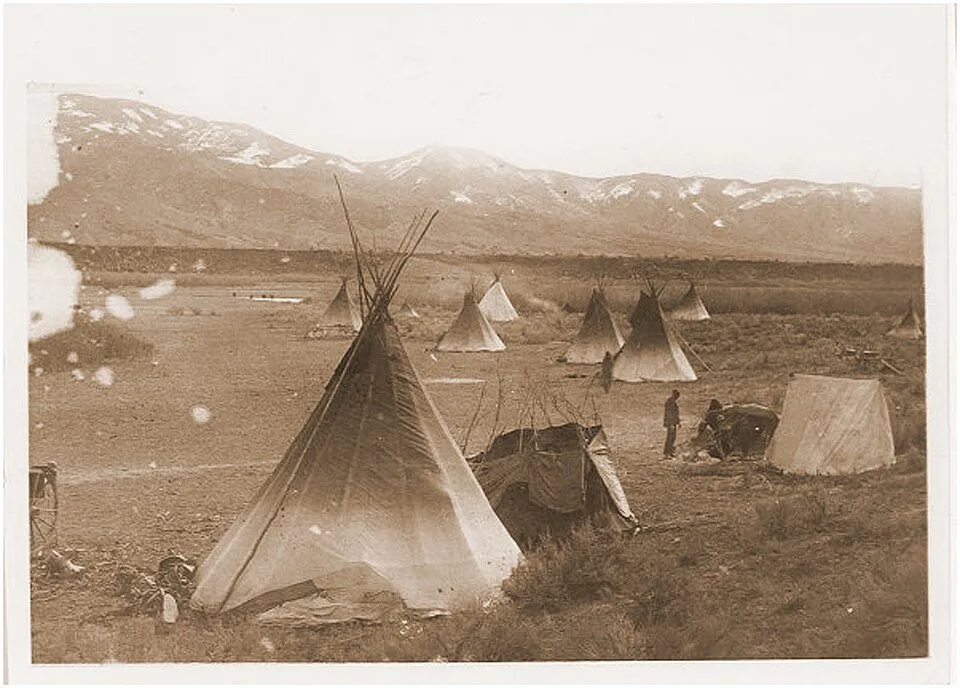
Long before my concrete was poured, people were living along this river. Native people have inhabited the country around American Falls for at least 10,000 years, and traditional tribal cultural sites and archaeological sites dating back that far still lie along the shoreline of my reservoir. When I speak of the history of this place, theirs is the first chapter, and it is by far the longest.
The Shoshone and Bannock peoples moved through this landscape with the seasons. Their traditional territories stretched over more than half of what is today Idaho and far beyond, and families traveled to fish for salmon, to dig camas roots, and to hunt. The Snake River was not a boundary in that world. It was a lifeline, a place to camp, to fish, and to gather, here at the falls and along the rich river bottoms upstream.
That world changed in the 1860s. On June 14, 1867, President Andrew Johnson issued an executive order designating the Fort Hall Reservation for bands of Shoshone and Bannock people. The following year, on July 3, 1868, tribal leadership signed the Fort Bridger Treaty, which affirmed that the Fort Hall Reservation would become the permanent home of the Shoshone and Bannock people. The treaty also preserved their rights to hunt, fish, and gather foods in their usual and accustomed places beyond the reservation boundaries.
My reservoir touches that homeland directly. The Snake River, the Blackfoot River, and American Falls Reservoir border the Fort Hall Reservation on the north and northwest, and about half of my shoreline lies within the reservation. The Fort Hall Bottoms, the wooded river bottom upstream from me, remain an important resource for the Tribes. When a larger second dam was planned in the 1960s, members of the Shoshone and Bannock communities opposed the expansion because it would have flooded still more of the Bottoms.
The Shoshone-Bannock Tribes are a federally recognized sovereign nation today, located between Pocatello, American Falls, and Blackfoot. For the past five decades, the Tribes have worked to restore the Snake River and its salmon runs, holding to the rights reserved in 1868 and to a connection with this river that predates my dam by thousands of years. I hold back the river for a season. They belong to it for all time.
Photo: Shoshone and Bannock tipis in 1882, near present-day Ross Park with Chinese Peak in the background, photographed before Pocatello was established. Idaho State Historical Society, via Wikimedia Commons, Creative Commons Attribution license.
