
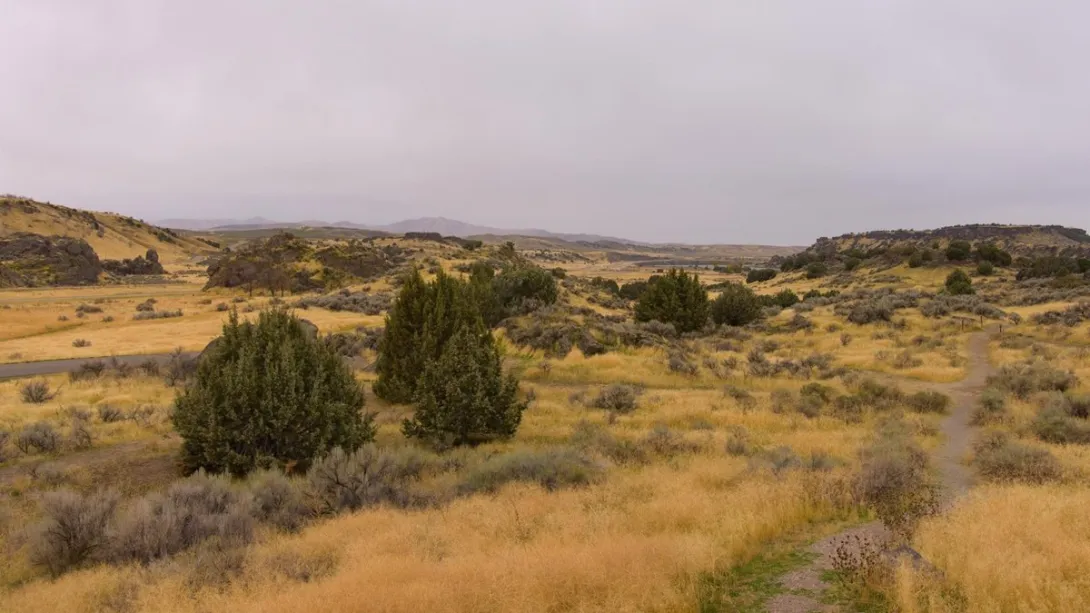
You can still walk in wagon tracks here. Ten miles southwest of town, Massacre Rocks State Park preserves visible remnants of the Oregon and California Trails, including deep ruts left by emigrant wagons that squeezed through the boulders along the Snake River, on the long road west that passed my river long before I held it back.
The ruts survive because the passage was narrow. Where wagons are free to wander, their tracks scatter and fade, but where the trail was funneled between rocks and river, every wheel followed the same line, season after season, until the line became a groove in the earth. A paved path at the end of Park Lane, northeast of the visitor center, leads right to those ruts today, and exhibits inside the visitor center tell the wagon trail story.
The rocks earned their fearsome name because emigrants feared an ambush in that narrow gap, where a wagon train was strung out and vulnerable. The fear was real even where the fighting was not: the skirmishes of August 1862 between emigrants and Shoshone fighters took place east of the park. Names on a landscape often record what travelers felt, not only what happened, and Massacre Rocks records the anxiety of the trail as faithfully as its ruts record the wheels.
Stand beside those ruts and the scale of the emigration comes into focus. Families walked this ground at a wagon's pace, with everything they owned behind oxen, measuring the distance to Oregon or California in months. My reservoir, my highway, and my town all came later, and all of them follow the same river corridor the wagons followed, because geography gives a region only so many good roads.
Long before my reservoir reshaped this river, this was the road west, and it is still here to walk. Go quietly, stay on the path so the ruts survive another century of visitors, and let the groove in the rock tell you how many wheels it took to write it.
