
In October 1972, the Bureau of Reclamation ordered that my reservoir no longer fill its top eight feet. That single restriction cut my storage by a third, from 1.7 million acre-feet to 1.1 million acre-feet, because the concrete of the original dam had weakened with age. For an irrigation reservoir, that was not an inconvenience. It was a threat to every farm that planned its year around my water.
The first dam had served since the 1920s, built by Utah Construction Company for the Bureau of Reclamation's Minidoka Project. Decades of water, weather, and chemistry had done their work on its concrete, and Reclamation's engineers would not gamble with a structure holding back the Snake River above a town. The eight-foot restriction bought safety at the price of storage, and everyone in the valley understood that the arrangement could not last.
So the valley organized. The American Falls Reservoir District joined the other thirty-four spaceholders, the water users who held storage rights in my reservoir, and went to Congress. They won Public Law 93-206, signed on December 28, 1973, which authorized my replacement and let the District itself coordinate the reconstruction. It was an unusual act of local self-reliance: the people who depended on the dam took responsibility for rebuilding it.
The financing matched that spirit. The District bonded 40 million dollars for the work, and Idaho Power agreed to retire 19.5 million dollars of those bonds over forty years, reflecting the value of the power the new dam would generate. Irrigation and electricity, the twin purposes of this river, quite literally paid for its future together.
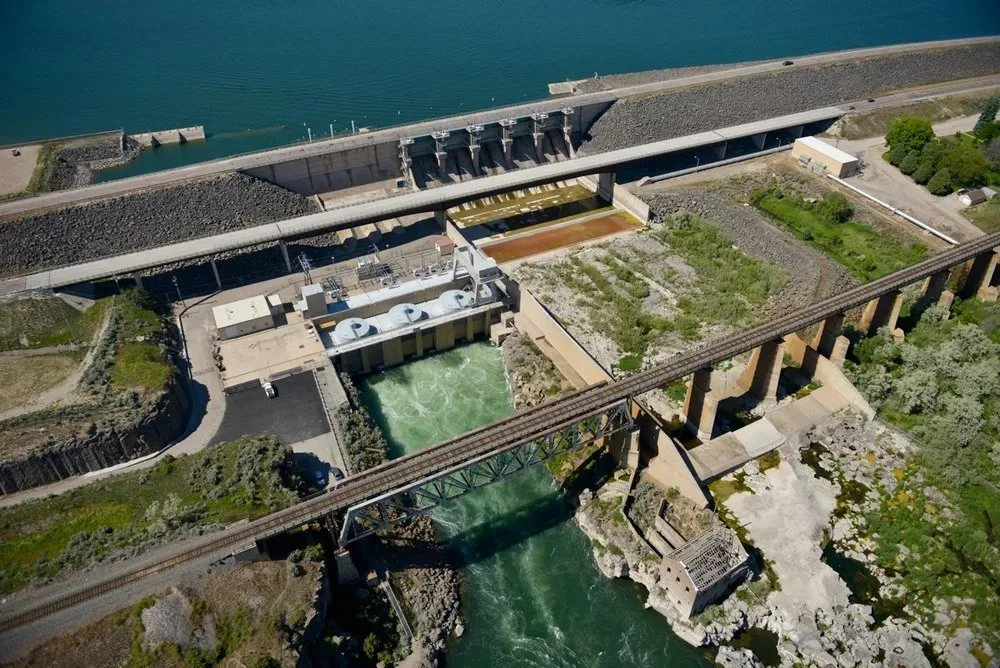
The new dam rose downstream from the old one and was completed in 1978, and then the old dam came down. I have held the Snake River safely for this valley ever since, at full pool, with the lesson of 1972 built into my concrete: a dam is a promise that has to be renewed, and this community, when the time came, renewed it.
