
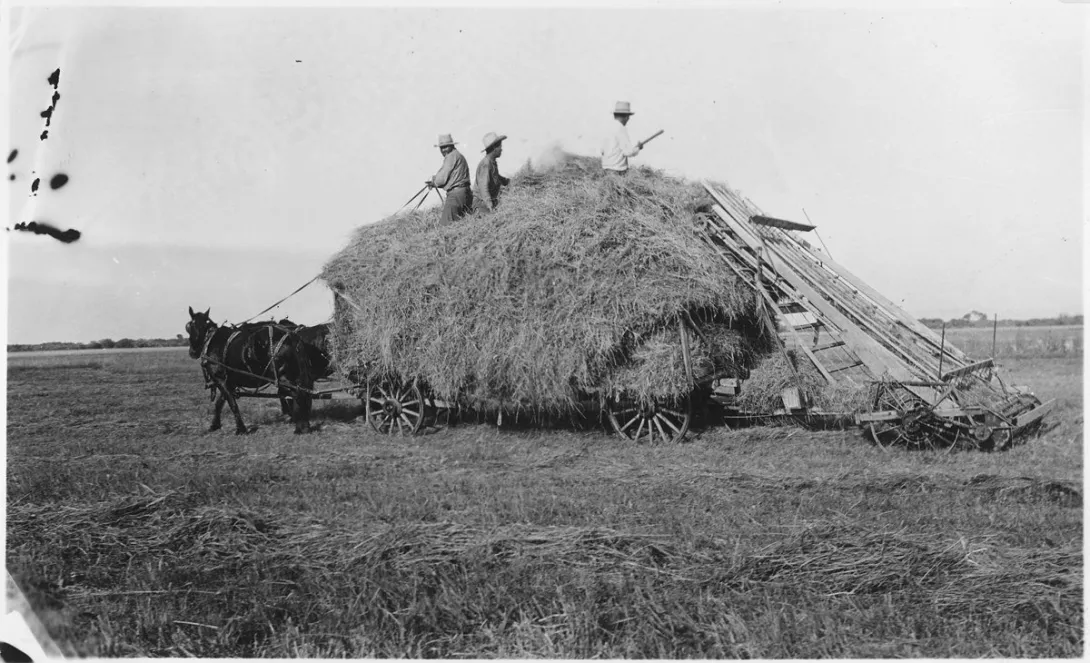
Long before my gates rose across the Snake River, the broad river bottomland northeast of me was already a homeland. The Fort Hall Bottoms, where the Portneuf River and spring creeks spread across the floodplain below the Blackfoot River, gave the Shoshone and Bannock peoples fish, waterfowl, roots, berries, and winter shelter. Families camped, hunted, and gathered there for generations, and the work of that life is preserved in a National Archives photograph from the Bottoms that shows hay being gathered with a horse-drawn wagon, a reminder that tribal families farmed and harvested this ground well into the reservation era.
The legal ground under that homeland was set in two steps. An executive order on June 14, 1867, first established the Fort Hall Reservation as the permanent home of the Shoshone-Bannock Tribes. The Fort Bridger Treaty, signed on July 3, 1868, then affirmed the reservation, and its Article IV reserved the Tribes' right to hunt on the unoccupied lands of the United States for as long as game could be found there. Those are not historical footnotes. The treaty rights endure today, and the Shoshone-Bannock Tribes remain a sovereign presence in this valley, with the reservation bordering the Snake River and my reservoir to the north and northwest.
My reservoir changed the edge of that homeland without erasing it. When my water rose, it backed toward the reservation boundary, and the Bottoms remained what they had always been, a working landscape of creeks, sloughs, and meadows where tribal members fish, hunt, and gather under rights older than the dam, older than the town, and older than the state itself. Every acre I hold back sits downstream of a much longer story.
So when you look northeast from my crest toward the cottonwoods and the wide green bottomland, you are not looking at empty scenery. You are looking at a homeland that was promised in writing, defended in practice, and lived in still. I am the newcomer here, and I try to remember it.
