
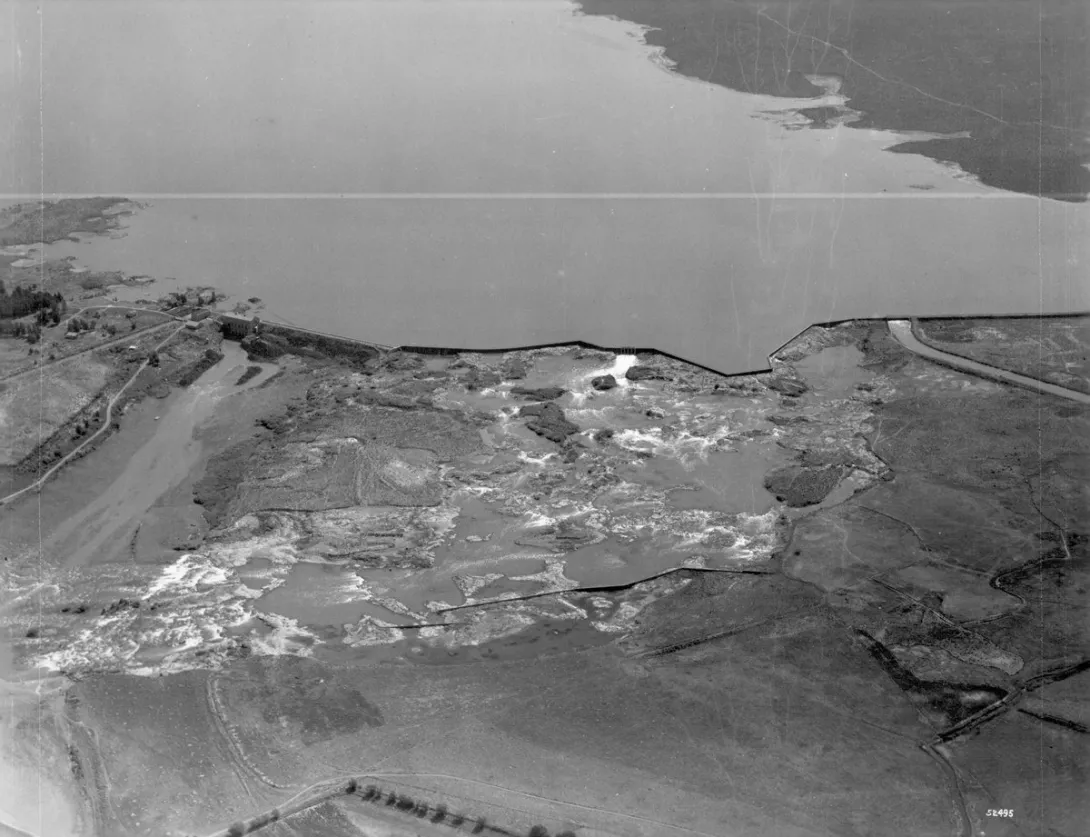
Some of my water travels far before it ever touches a field. On September 30, 1950, Congress authorized the North Side Pumping Division of the Minidoka Project, some 77,000 acres of new irrigation country in Minidoka and Jerome Counties. It was one of the Minidoka Project's boldest expansions, and it began with water stored behind dams like mine.
The division worked in two parts. Its Unit A pumped water stored here at American Falls and in Palisades Reservoir, lifting river water up to lands too high for gravity canals. Unit B took a different approach, lifting groundwater from deep wells. Together, pumps and wells did what the lay of the land would not do on its own.
The Bureau of Reclamation finished building the division in 1959 and handed operations to the A and B Irrigation District in 1966. That handoff is a familiar pattern in reclamation history: the federal government builds the works, and the local district of water users runs them day to day, season after season.
The result was written across the landscape. Sagebrush plain became farmland, and tens of thousands of acres that had waited on rain alone joined the irrigated economy of the Snake River Plain. Every acre of it traces back to storage, and some of that storage has always been the water I hold back each spring for summer.
When you drive the farm country north of the river, you are looking at the far end of a system that starts at dams like mine. Storage, pumps, wells, and canals turned a river's spring rush into a whole region's livelihood, and the North Side Pumping Division is where that idea climbed uphill.
The division also shows how the Minidoka Project kept growing long after its first dams and canals were finished. Each new unit answered the same question in a new place: how far can stored Snake River water be made to go? On the north side, with pumps humming against the slope, the answer turned out to be a whole new farming country.
