
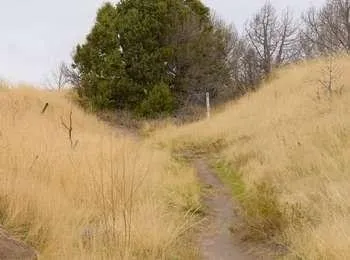
Some historic places are buildings. This one is a road worn into the ground. Southwest of American Falls, in the Register Rock area, the Oregon Trail Historic District protects two segments of unaltered Oregon Trail, listed on the National Register of Historic Places on March 20, 1973. Both the Oregon Trail and the original California Trail passed this way, carrying emigrants beside the Snake River on their long road west.
At the Massacre Rocks Rest Area on Interstate 86, at milepost 31, a short walk leads to deep, extensive wagon ruts and swales that are still visible today. Thousands of wagon wheels, grinding over the same line season after season, pressed the trail into the earth so firmly that it remains readable more than a century and a half later.
This stretch of trail belonged to one of the hardest and most storied parts of the journey. Emigrants followed the Snake River through a country of basalt and sagebrush, stopping at landmarks such as Register Rock, where many carved their names into stone, and passing the boulder field the trail remembered as Massacre Rocks. The district preserves the ground itself, not a reconstruction of it.
Because the segments are unaltered, a visit asks for a light step. Stay on established paths, view the ruts rather than walking in them, and leave every stone and artifact where it lies. What survives here is fragile precisely because it is only earth, grass, and memory, protected since 1973 so future travelers can still read it.
From my crest, the interstate hums past in minutes what wagons covered in days. Slow down at the rest area, take the short walk, and stand beside a road that carried half a continent of hopes west. Few landmarks near American Falls speak as quietly, or as clearly.
